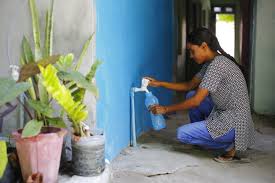
What is a water supply disruption?
A water supply disruption refers to any interruption or failure in the delivery of safe and potable water for domestic, industrial, or economic use.
In the Maldives, potable water includes desalinated water, harvested rainwater, bottled water, and to a limited extent filtered groundwater. Water supply disruptions can last from a few hours to several days depending on the cause and the availability of backup systems.
Water is essential for drinking, hygiene, healthcare, and daily living. As a result, disruptions can quickly affect public health, sanitation, and the functioning of essential services across entire islands.
How does the water system operate in the Maldives?
Due to the geographic dispersion of islands, water supply systems in the Maldives are island-based, with each inhabited island operating its own water production and distribution system.
Historically, freshwater was sourced from underground aquifers and rainwater harvesting. However, increasing population and contamination of groundwater led to a transition towards safer and more reliable systems.
Today, most islands rely on:
Desalination systems (reverse osmosis) to produce freshwater from seawater
Rainwater harvesting systems at household and community levels
Storage tanks and distribution networks to supply water to households
As of recent years, desalination systems have been established across most inhabited islands, significantly improving access to safe water.
However, many systems:
Operate with limited redundancy
Depend on continuous power supply
Rely on imported spare parts and technical maintenance
This makes them vulnerable to both technical failures and external disruptions.
Why water supply disruption is a growing risk
Water demand in the Maldives has increased significantly due to population growth, urbanization in particular in Greater Male' Area and regional centers as well as expansion of tourism and economic activities.
The system faces growing pressures including:
Heavy reliance on desalination systems, which are energy-intensive
Dependence on electricity and fuel supply to operate water systems
Limited storage capacity on smaller islands
Dependence on imported equipment and spare parts
Geographic challenges in transporting water and equipment across islands
Climate related factors such as prolonged dry periods, heavy rainfall, flooding, and saltwater intrusion further increase vulnerability. These combined factors make water supply systems increasingly sensitive to both technical failures and external shocks.
What can trigger water supply disruptions?
Water supply disruptions in the Maldives can be caused by:
Because most islands operate without backup systems, even a single system failure can result in island-wide water outages.
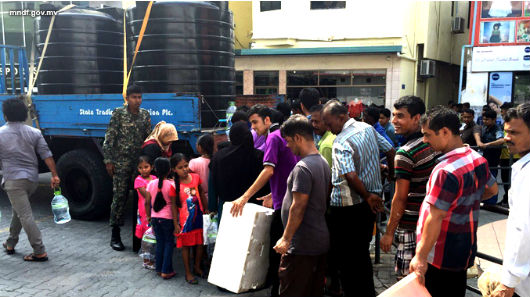
Emergency water distribution in Greater Male' Area, during Water Crisis 2014 | Photo: NDMA
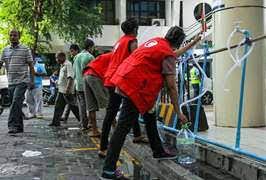
Emergency water distribution in Greater Male' Area, during Water Crisis 2014 | Photo: NDMA
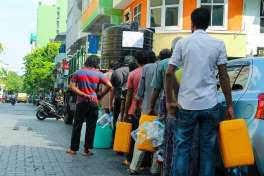
Emergency water distribution in Greater Male' Area, during Water Crisis 2014 | Photo: NDMA
What impacts can water supply disruption cause?
Water supply disruptions can have widespread and cascading impacts:
In prolonged disruptions, there may also be:
Increased public distress and pressure on authorities
Higher environmental impacts due to plastic waste from bottled water
Because water systems are closely linked to power and sanitation systems, disruptions can quickly amplify the impacts of other hazards.
Reducing risk through preparedness and system strengthening
Water supply disruption in the Maldives can have direct impact on health, livelihoods, and essential services. Reducing risk depends on:
Strengthening and climate-proofing water infrastructure
Increasing system redundancy and backup capacity
Expanding storage and rainwater harvesting systems
Improving maintenance and technical capacity
Reducing reliance on single-source water systems
Strengthening emergency water supply and distribution planning
At the household level, preparedness includes:
Maintaining emergency water storage
Conserving water during shortages
Following official advisories on water safety and usage
Combining household preparedness with system-level improvements is essential to ensuring water security and resilience across island communities.